Wednesday, October 16, 2019

The Fundamentals for Gold & Gold Stocks are Outstanding


Gwen discusses the reasons why the gold bear market has ended and how it is different from what most investors anticipated. 

Global currencies are in a race to the bottom as countries compete for trade, and central banks continue to cut interest rates. 

Today's investors are uncertain, and they are looking for a new "safe haven," and that is likely to be gold.

- Source, Palisade Radio

Monetary Inflation and the Next Big Crisis

We regularly look at what’s happening with monetary inflation around the world, but today we’ll focus exclusively on the US monetary inflation rate. This is because of the recent evidence that the unusually-low level of this long-term monetary indicator is starting to have a significant short-term effect.

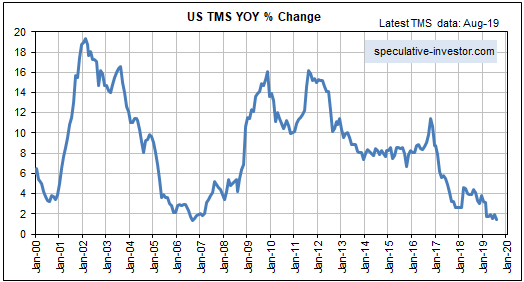
The following chart shows that the year-over-year rate of change in US True Money Supply (TMS), a.k.a. the US monetary inflation rate, made a new 12-year low in August-2019. Furthermore, the latest TMS growth figure for the US is very close to the 20-year low registered in September-2006.


Within three months of the TMS growth trough in September-2006 the first obvious crack appeared in the US mortgage debt/securitisation bubble. The crack was a trading update issued by HSBC on 5th December 2006 that noted the increasing “challenges” being faced by the Mortgage Services operations of HSBC Finance Corporation. 

This initial sign of weakness was followed by the appearance of a much larger crack on 7th February 2007. That’s when HSBC issued another trading update that included a profit warning due to substantially increased loan impairment charges. Within days of this February-2007 HSBC update, the shares of sub-prime lending specialists such as New Century Financial and NovaStar Financial went into freefall. This marked the beginning of the Global Financial Crisis, although the US stock market didn’t top out until October of 2007 and industrial commodities such as oil and copper didn’t top out until mid-2008.

The above-mentioned events could be relevant to the current situation, in that the recent chaos in the US short-term funding market could be the initial ‘crack’ in today’s global debt edifice. While the low rate of US monetary inflation was not the proximate catalyst for the recent chaos, there is little doubt that it played a part. Temporary issues such as a corporate tax deadline and a large addition by the US Treasury to its account at the Fed would not have had such a dramatic effect if the money supply had been growing at a ‘normal’ pace.

Generally, when the money supply is growing very slowly within a debt-based monetary system, a relatively small increase in the demand for cash can create the impression that there is a major cash shortage.

Now, if there’s one thing we can be sure of it’s that the next crisis will look nothing like the last crisis. The financial markets work that way because after a crisis occurs ‘everyone’, including all policy-makers, will be on guard against a repeat performance, making a repeat performance extremely improbable. Therefore, we can be confident that even if the recent temporary seizure of the US short-term funding market was a figurative shot across the bow, within the next couple of years there will NOT be a major liquidity event that looks like the 2007-2008 crisis. However, some sort of crisis, encompassing an economic recession, is probable within this 2-year period.

The nature of the next crisis will be determined by how the Fed reacts to signs of economic weakness and short-term funding issues such as the one that arose a few weeks ago. In particular, quick action by the Fed to boost the money supply would greatly reduce the probability of a deflation scare and greatly increase the risk that the next crisis will involve relatively high levels of what most people call “inflation”.

As an aside, there’s a big difference between the Fed cutting its targeted short-term interest rates and the Fed directly boosting the money supply. For example, in reaction to signs of stress in the financial system the Fed commenced a rate-cutting program in September of 2007, but it didn’t begin to directly pump money into the system until September of 2008. In effect, during the last crisis the Fed did nothing to address liquidity issues until almost two years after the appearance of the initial ‘crack’. As a consequence, the monetary inflation rate remained low and monetary conditions remained ‘tight’ until October of 2008 — 12 months after the start of an equity bear market and 10 months after the start of an economic recession.

Early indications are that the Fed will be very quick to inject new money this time around, partly because 2007-2008 is still fresh in the memory. These early indications include the rapidity of the Fed’s response to the effective seizure of the “repo” market last month and the fact that last Friday the Fed introduced a $60B/month asset monetisation program. This program is QE in everything except name. In other words, the Fed already has resumed Quantitative Easing even though GDP is growing at about 2%/year, the unemployment rate is at a generational low and the stock market is near an all-time high.

In summary, while it is too early to have a clear view of how the next major crisis will unfold, something along the lines of 2007-2008 can be ruled out. Also, there are tentative signs that the next crisis will coincide with or follow a period of relatively high “inflation”.

- Source, TSI Blog

Tuesday, October 15, 2019

Ned Naylor-Leyland: Silver and Gold in the Modern Portfolio


The question of whether precious metals have a place in one's portfolio is a never-ending debate, but an equally important yet often-overlooked question is "how much"? 

Ned Naylor-Leyland of Merian Global Investors discusses the role that gold and silver can play, and the important differences between sizing bullion versus sizing mining stocks. 

He also provides his theory for why central banks continue to accumulate bullion in their own portfolios.

Saturday, October 12, 2019

Demand for Gold ETF's Surge as Quantitative "Not" Easing Returns

The Federal Reserve has cut interest rates twice this year, slashing rates lower in an attempt to spur the economy and keep the good times rolling.

Despite this fact, the markets are not happy and they have demanded more and as it now appears, they are going to get exactly what they wished for.

The odds of an additional rate cut occurring within 2019 has surged higher, with market analyst predicting overwhelmingly that another rate cut is on the way and soon.

The reasoning for this is the Federal Reserve themselves, as they have proven that they will not and are not going to let the free market regulate itself, as seen in their recent intervention in the short-term lending markets throughout the month of September, in which they rushed in to save the day.

The Financial Times reports;

"In recent weeks, the Federal Reserve Bank of New York has injected billions of cash reserves into short-term lending markets to ease the pressures that bubbled up in September and sent the cost of borrowing cash overnight via repurchase, or repo, agreements as high as 10 per cent."

Despite these bail-outs, the short-term lending markets are still seen as on shaky ground and incredibly vulnerable to a repeat collapse.

This has prompted the Federal Reserve to take even further action, announcing that they would once again resume purchases of Treasury Securities from the open market, in an attempt to keep the system chugging alone.


At the National Association for Business Economics conference in Denver on Tuesday, Federal Reserve Chairman Powell explained  how the Fed plans on supporting the markets moving further, however, he strongly stressed that this should not be viewed as Quantitative Easing, stating the following;

“I want to emphasize that growth of our balance sheet for reserve management purposes should in no way be confused with the large-scale asset purchase programs that we deployed after the financial crisis.”

Reiterating this point, Powell would later go on to state;

“In no sense, is this QE,”
Obviously to anyone with half a brain, the above statement by Powell is pure nonsense, as this is obviously QE, whether the Fed wants it to be or not.

This recent softening by the Federal Reserve, in addition to the ongoing geopolitical risks that seem to be plaguing much of the world, has resulted in a massive surge into Gold ETF's as market participants seek the protection that only the king of metals can provide.

ETF gold holdings reached an all time high in the month of September, resulting in the longest run higher in holdings, in the past decade. With the most notable being holdings within the UK.


The last time that such demand for gold ETF's was seen was shortly after the 2008 financial crisis, which does not bold well for what may be coming just over the horizon.

According to the World Gold Council, gold backed ETFs added 75.2 tons of metal to their holdings last month, bringing the total to 2,808 tons.

This surpasses the previous record set in 2012, when gold was at $1,700 per ounce, highlighting just how underpriced gold is at the moment.

Despite these warning signs, signals from the Fed and the deteriorating geopolitical climate around the world, gold stubbornly remains around the $1500 USD per ounce level, struggling to break higher.


2020 is going to be one for the record books and I believe that anything could happen as we head into the US Presidential Elections, with political violence and uncertainty creating a powder keg style situation.

These artificially suppressed prices are not going to last much longer, as the fundamentals for higher gold prices are inevitably going to win the day and precious metals are going to surge higher as we head into an even more tumultuous and unpredictable next year.

Until then, enjoy these prices while you can and as always, keep stacking.

- As first seen on the Sprott Money Blog

Thursday, October 10, 2019

What Is Your Next Strategy After Gold Goes Parabolic?


What Is Your Next Strategy After Gold Goes Parabolic? Wall Street cookie cutter investment plans don’t work. 

When gold rose from $700 to $1900 there were five $100 corrections. China & India buying increase whenever gold corrects down.

Wednesday, October 9, 2019

Rob McEwen: Is the gold price still in good shape and how to stomach volatility


Gold prices may have had a rough start to the week, but the long-term trend remains bullish and investors should not get sidetracked by noise, said Rob McEwen, chairman of McEwen Mining. 

“Despite the last few days, the trend is much higher,” McEwen told Kitco News. “Buy when you have that opportunity, because the momentum is building.”

- Source, Kitco News

Sunday, October 6, 2019

The Case Against Numismatic Gold for Wealth Preservation


Little did I know as I ventured into conversations about owning physical gold, that discussing the option of buying collectable, rare, or “numismatic” coins would draw such heated controversy from multiple corners. 

Many of the topics we’ve addressed to help us all be aware and prepared have encountered polarized positions and world-views (cryptos vs. precious metals, vault storage vs home-storage, and online purchasing vs. cash-in-hand private and local, etc..).

But the extreme views of people I’ve encountered who are earnestly devoted to or repelled by numismatic coins has convinced me that we’ve got to take a closer look, and bring this controversy out of the trenches and into the light of open, civil debate to discern the facts and data, and help us all be better informed. 

So whether each of us may hold deep-seated views, or a casual opinion, or haven’t even heard of or thought about the virtues vs. risks of acquiring “collectible” coins, I hope we will all learn from this discussion, and come away better prepared to protect our family’s financial well being. 

This guest, Franklin Sanders, known as “The Money Changer,” and founder of The-MoneyChanger.com, has been in the gold & silver business for 40 years. 

Sanders visits Reluctant Preppers this first time to explain his experienced view of the factors affecting premiums on collectible gold coins, and why he says the data argues “against” buying numismatic coins as a part of your wealth preservation strategy.

Saturday, October 5, 2019

Fears of a Global Recession Grow, Gold and Silver Rally

With each passing day, the chances of the United States and in all likelihood, the entirety of the global economy entering into a deep recession grows.

The trade wars continue on and as I have written about numerous times in the recent past, I can't see a solution on the horizon, this is bad news in the short term for not only China, who relies heavily on the United States, but also the US economy as well.

Neither party is willing to budge and Central Bankers around the globe are beginning to come to the stark realization that things are going to get a whole lot worse, before they get better.

This is exactly why the FED is cutting rates, this is why the European Central Bank plans on once again entering into a massive stimulus program, as they know that a reckoning is coming.

Confirming this new reality, the World Trade Organization once again cut its forecast for global trade growth on Tuesday.

The Washington Post reports;

"On Tuesday, the WTO said world merchandise trade volume is expected to rise 1.2 percent in 2019 — markedly slower than the 2.6 percent forecast in April. For 2020, the forecast estimates 2.7 percent growth instead of 3 percent.

The revised projections come less than two weeks after President Trump called China a “threat to the world” and said there was little urgency for an interim trade agreement. On Sept. 20, he told reporters he was under no pressure to reach a deal with China before the 2020 election, despite his early insistence that China was eager to return to the negotiation table."

Further confirming this news, it is reported that both US and Chinese manufacturers have entered into recession territory, as the ISM’s U.S. manufacturing Purchasing Managers Index fell to 47.8% last month.

According to CNBC, this is the worst level in a decade, with the index not seeing these numbers since June 2009, when the United States was going through its "great recession" after the 2008 collapse.

Unfortunately, as many of you know, when the United States sneezes, the world gets a cold and already, it appears that the contagion is spreading, with countries such as Singapore reporting that its economy is also "tipping" into recession.

All this negativity and talks of recession, caused gold and silver to plummet lower in price early this week.


(Charts via Goldprice)

Fortunately, it appears that market participants regained some semblance of sanity as the week dragged on, with both gold and silver recovering much of their earlier week losses.

As it stands now, gold bullion has moved once again above $1500 USD per ounce, while silver bullion stands at $17.70 USD per ounce.

These are important levels to maintain and any protracted time spent below these levels could mean much lower prices, however, given the fundamentals it seems unlikely that this will be the case.

Central bankers around the world are now fully aware that we are about to enter into a dragged out global recession as the trade wars continue to go on, with no end in sight.

This means that interest rates around the world are going to be slashed by Central Bankers, stimulus programs are going to once again be all the rage and the money printing is going to be happening at a feverish pace.

In addition to this, the Democratic party in the United States seems hell bent on moving forward with impeachment proceedings against President Trump, a plan that appears to be pivotal in their 2020 election campaign strategy and nothing further, as it is incredibly unlikely that he will be impeached and removed from office.

Even if the House does vote to impeach, the Senate, which is controlled by Republicans are not going to vote to remove him from office, as 2/3rd's must do so.

Unfortunately for the Democrats, I along with many others believe that this is going to backfire on them, as it is only going to embolden Republicans and result in a staggering high turnout for the President come 2020.

Regardless, uncertainty abounds and precious metals are going to take notice as this political theater continues to unfold.

People should not be selling gold and silver bullion as we saw earlier in this week, but in fact be buying it hand over fist in the coming climate.

Expect much higher prices as global risk grows and as QE to infinity goes worldwide.

Keep stacking. Focus on the long term. Ignore the short term noise.

- As first seen on the Sprott Money Blog

Friday, October 4, 2019

The Most Important Technical Indicator For Trading Gold and Silver


Expert technical analyst & professional trader JC Parets says that over the last two years, we've seen the U.S. stock market bear market, and we're closer to the start of a new bull market than we are to a crash, but that doesn't stop JC from turning bullish on gold & silver. 

JC says once gold breaks-out above $1,600, there's no denying this bull market is on, a bull run which likely leads to a $10,000 gold price based on the technical analysis alone.

- Source, Silver Doctors

Thursday, October 3, 2019

The Real Problem With Low Interest Rates...


We review the recent BIS paper which highlights the issues with low interest rates.

- Source, Walk the World

Sunday, September 29, 2019

Insights From The 2019 Denver Gold Forum


Apparently Canadian investment bankers are working on a lot of mergers and acquisitions among mid-tier primary gold miners. 

Not all the deals will go through but it sounds like many are being worked in because many producing miners cannot raise enough capital to fix their balance sheets and remain on their own.

Saturday, September 28, 2019

Out Of Control Healthcare Costs: Cost of Annual Family Health Coverage in the US Now Tops $20k


The cost of family health coverage in the U.S. now tops $20,000, an annual survey of employers found, a record high that has pushed an increasing number of American workers into plans that cover less or cost more, or force them out of the insurance market entirely.

- Source, Wall St for Main St

Thursday, September 26, 2019

Ron Paul: Negative Rates Can’t Save The Empire, It’s The Debt Stupid


Central Planning is always destined to fail, and central planners (at everyone else's expense) always do whatever they can to delay the inevitable. 

Negative interest rates (that is, getting paid to borrow money) would never occur in a free market monetary system. Such a ludicrous idea will only further exacerbate the end of central banking. 

Debt continues to skyrocket, and the interest payments will only get more unbearable. It's time to audit and then End The Fed.

- Source, Ron Paul

US Constitutional Crisis? Not According to Gold Bullion

The system is collapsing, the markets are crashing and gold and silver bullion are soaring higher, attempting to protect its investors from the impending doom that is about to befall us all..

Or not.

The Main Stream Media is at it again, beating the war drum and attempting to rile up the people of the United States, the markets and anyone else that will listen, after all, you've got to get those clicks.

The hub hub that I am referring to is in regards to the ongoing "constitutional crisis" taking place, as I write this article, in the United States.

A "whistle blower" in the Intelligence Community has stepped forward, with damning information, that he / she heard from a guy that knows a guy, who knows for a fact that President Trump is attempting to circumvent the election process, big league.

Straying from tradition and in record breaking fashion, the Trump administration released the transcripts of the supposed incident that took place via phone, with the President of Ukraine, in which the "whistle blower" believes the President attempted to garner foreign interference in the upcoming 2020 elections, by having Ukraine investigate Joe Bidens and his son, Hunter Biden.

This of course would be very concerning if true, even if there was undoubtedly some funny business that took place regarding Hunter's "incident" while Vice-President Biden was in office.

To read more about the background surrounding this past event, I suggest Karl Rove's recent Op-Ed that appeared in the WSJ this morning.

If all of these allegations were true, then you would expect that President Trump and his administration would go into immediate "lock down" mode, making it as difficult as possible for the opposition to investigate his "wrongdoings". Which is what I believe both the Democratic party and the MSM thought was going to unfold.

Much to their surprise, not only did the Presidents administration release the phone call transcripts, but also the whistle blowers memo, with only minor redactions, of which you can read below;


A few key takeaways from the whistle blowers complaint, include, self admittedly, that they were not personally privy to any information first hand, but received news of wrongdoing from others;

In the course of my official duties, I have received information from multiple U.S.
Government officials that the President of the United States is using the power of his office to solicit interference from a foreign country in the 2020 U.S. election."


"Over the past four months, more than half a dozen U.S. officials have informed me of various facts related to this effort."

"I was not a witness to most of the events described... However, I found my colleagues' accounts of these events to be credible..."

Many of you know that I am not the biggest fan of President Trump, nor many of the choices he has made while in office, however, I also am not blind to the fact that he has received the most negative coverage via the MSM, of any President in history.

Once again, this appears to be another "nothing burger", especially given the fact that the markets are simply yawning over this "constitutional crisis".

Let's take a look at the current price of gold bullion in the last five days of trading action;


(Chart via GoldPrice)

Wait down? This can't be right, gold should be rapidly moving higher if a "constitutional crisis" was currently unfolding, as risk would be exploding higher.

The markets must be telling a different story;


(Charts via MarketWatch)

Now that's a market collapse if I've ever seen one! Both the Dow Jones and the S&P 500 are down less than 1%.

But, what about the people, the men and women on the street, they are the ones that truly matter, especially with the 2020 elections rapidly approaching;


What?

While this news was breaking, Rasmussen, one the largest polling firms in the United States had President Trumps approval rating at 51%, which is 7% higher than President Obama's, at the exact same number of days in office, the latter of whom did not have a "constitutional crisis" unfolding at the time.

All sarcasm and joking aside, clearly this story is yet to fully unfold, but unfortunately for the Democratic party and the MSM, the latter of which continues to discredit themselves more and more everyday, this looks like a massive miss, which could backfire on them "big time", as Karl Rove stated in his recent Op-Ed.

This game can only be played so many times before people simply stop believing these type of "breaking news" stories altogether, of which I believe is the point we are now approaching.

The stock market, gold bullion, the people and the current evidence being presented all points to the true reality, there is no crisis.

As I have written about numerous times in the past, the 2020 elections are going to be dirty, they are going to be nasty and the world is going to be taken on a roller coaster of a ride, as the greatest reality TV show to ever be presented unfolds in front of our very eyes.

Strap yourselves in and keep stacking, madness approaches.

- Source, As first seen on the Sprott Money Blog

Wednesday, September 25, 2019

Expert who called $1500 gold is now betting on $20 silver in two months


E.B. Tucker, director of Metalla Royalty & Streaming, doubled down on his bet earlier this year that gold would eventually rise to $1,500, an now he’s betting that silver will hit $20 in the next two months. “Right now, we want to trade silver up to $20. 

We think gold is going to stabilize at $1,500 and we see silver moving to $20, so that’s a 12% move we think we can capture in the next probably eight weeks. 

We see that as pretty much a certainty, and we’re willing to bet on that,” Tucker told Kitco News on the sidelines of the Denver Gold Forum.

- Source, Kitco News